 |
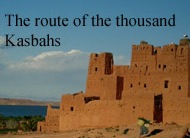
THE ROUTE OF THE THOUSAND KASBAHS |


|
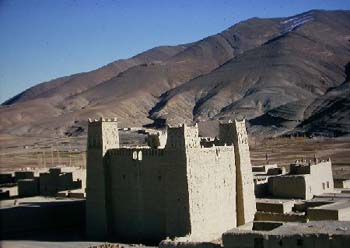
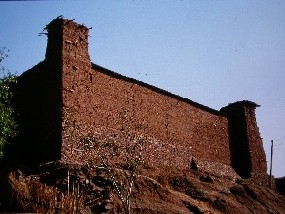
What is a Kasbah?The word Kasbah has a very large sense. In each country, and even in each region, it applies to a different type of building: from a fortress isolated in the country to a city neighborhood where the members of the administration and the army lived. In southeastern Morocco, however, the word Kasbah is usually applied to a square building with four towers at the corners, built with soil and usually destined to live in it a powerful family. Its origin is Berber and in this language it is called Tighremt. The word Kasbah is recent and linked to the arrival of Arab citizens to areas where there were such monuments. The oldest Kasbahs may be dated in the eighteenth century, perhaps some of them in the seventeenth, but most do not have much more than one hundred years, since previously the presaharic valleys population lived within the Ksour.
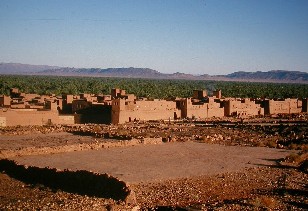
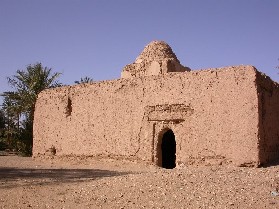
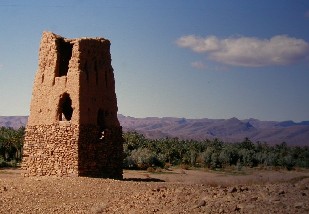
A Ksar (plural, Ksour) is a walled town protected by watchtowers, which includes in its inner some tens or even some hundreds of homes, in addition to the mosque, the streets, a square for celebrations and other community facilities. All the Ksour include one or many monumental gates, some of them very well decorated. Most of the Ksour are more ancient than the Kasbahs, even thousand-years-old, but there are also some of them built in the nineteenth century by formerly nomadic tribes. In some places we find one or many Kasbahs inside a Ksar. The Ksour are much more abundant in the eastern valleys, while Kasbahs dominate the west area. SEE MAP OF THE DISTRIBUTION OF KASBAHS AND KSOUR In addition to the Kasbahs and Ksour, in this region are also other traditional buildings made by soil: the shrines covering the tomb of a saint; the community barns and the isolated watchtowers. For tourists, nevertheless, all these is usually included into the concept Kasbahs when speaking about the famous Route.
In recent years, moreover, a growing number of hotels and restaurants accompany its name with the word Kasbah to make it more attractive, although in many cases it's a block of reinforced concrete of recent construction. As consequence of this attitude, the term "Kasbah" is losing its original meaning and maybe after some time it will simply mean "hotel". In any case, all Kasbahs we mentioned on this website are real old buildings (more than half a century), made with soil. Contact with the author:
© Roger Mimó |

 |
 |
 |
 |
 |
 |
 |
 |
 |
 |